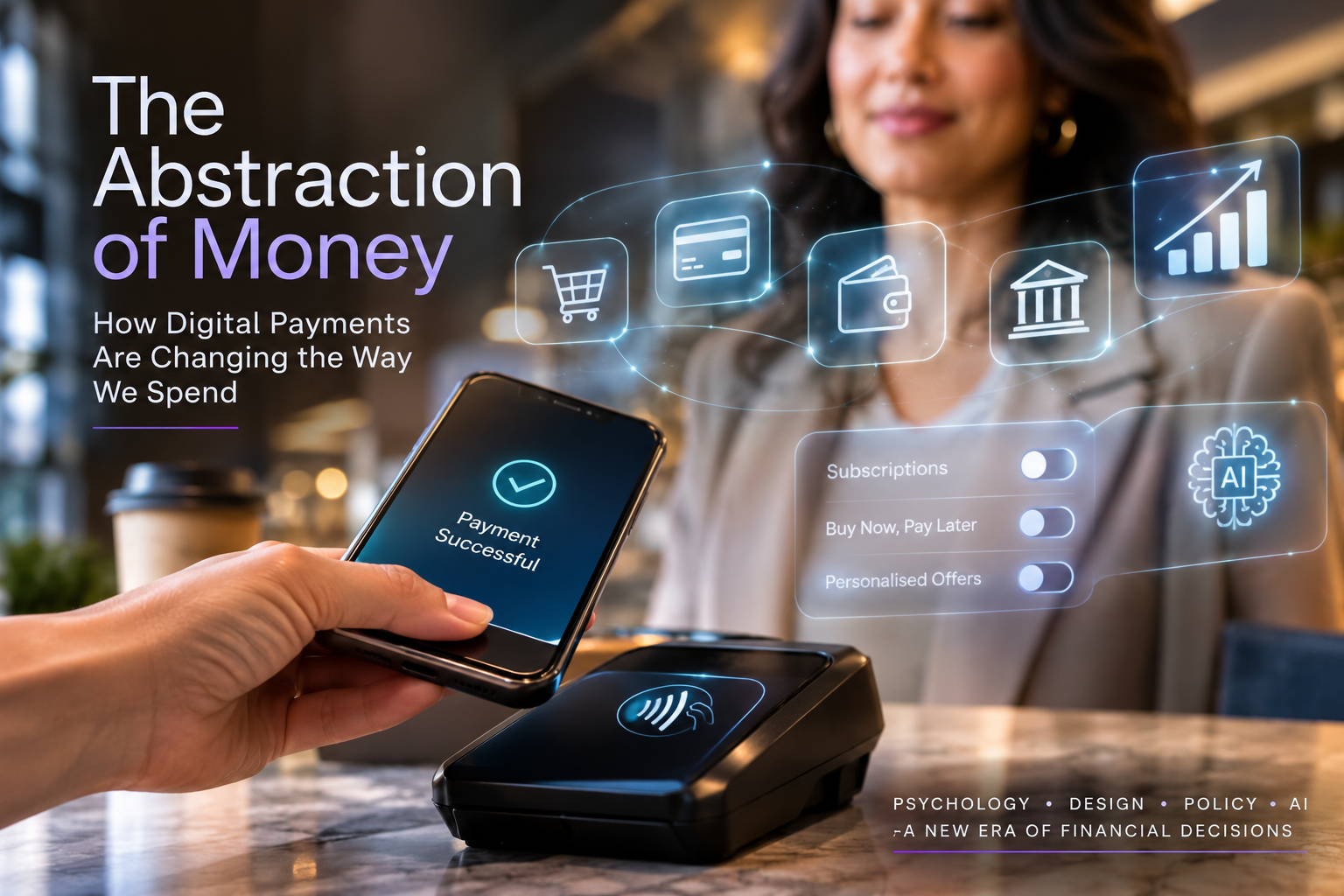
Cómo la tecnología de pagos, el diseño conductual y la inteligencia artificial están transformando las decisiones de los consumidores y su concienciación financiera.
El dinero se ha vuelto cada vez más digital. Pagamos el café con el móvil, nos suscribimos a servicios con un clic, compramos productos por Internet y gestionamos transacciones sin necesidad de manejar dinero en efectivo.
La transacción puede durar unos segundos. Sin embargo, el compromiso financiero puede prolongarse mucho más allá del momento de la compra.
Esta transformación no solo ha cambiado los mecanismos de pago, sino que también ha modificado el entorno en el que los consumidores toman sus decisiones de gasto. La relación entre comprar y pagar se está volviendo menos tangible, mientras que las plataformas digitales influyen cada vez más en lo que vemos, en cómo se presentan las opciones y en la facilidad con la que completamos una transacción.
Por lo tanto, para comprender cómo gastamos, debemos ir más allá de los hábitos individuales. Debemos analizar la psicología del pago, el diseño de los entornos digitales, los incentivos comerciales que hay detrás de ellos, las políticas destinadas a proteger a los consumidores y el papel cada vez más importante de la inteligencia artificial en la toma de decisiones financieras.
Para aquellas personas que desean conservar una mayor parte de sus ingresos y reforzar su capacidad financiera, estos cambios son importantes. Puede que el dinero sea ahora menos visible, pero sus consecuencias económicas siguen siendo tangibles.
1. El dinero ha cambiado. ¿Ha cambiado también la experiencia de gastar?
Pensemos en una experiencia que nos resulte familiar.
Compras un café mediante pago sin contacto. No hace falta sacar la cartera, contar billetes ni recibir cambio. Basta con un pequeño movimiento del móvil o de la tarjeta para completar la transacción.
Más tarde, compras algo por Internet. Tus datos de pago ya están guardados. Con un solo clic confirmas el pedido.
También es posible que tengas suscripciones que se renuevan automáticamente, pagos que se deducen de tu cuenta y compras que se pagan a plazos.
Cada transacción resulta cómoda. Sin embargo, la experiencia de gastar es diferente a la de entregar el dinero en mano.
Históricamente, el dinero en efectivo representaba de forma visible un intercambio. Se podía ver cómo disminuía la cantidad que había en la cartera. Con los pagos digitales, la transacción se registra electrónicamente, pero se reduce la experiencia física de que el dinero deje de estar en tu poder.
Esta distinción es importante porque el gasto no es simplemente un ejercicio matemático. También es un proceso conductual.
La forma en que pagamos puede influir en cómo percibimos el coste económico de una compra. La rapidez, la visibilidad y la comodidad de una transacción pueden afectar a la atención que le prestamos.
Los pagos digitales no son intrínsecamente irresponsables, ni el uso de efectivo implica automáticamente que se tomen mejores decisiones financieras. Los pagos electrónicos ofrecen ventajas considerables, entre las que se incluyen la comodidad, la accesibilidad, la rapidez y el registro de las transacciones.
La cuestión no es si los pagos digitales son buenos o malos, sino cómo influye la evolución de la experiencia de pago en las decisiones que tomamos.
2. La psicología del pago: ¿Por qué se percibe el gasto de forma diferente?
La economía conductual ayuda a explicar por qué el acto de pagar puede influir en la experiencia de consumo.
Un concepto importante es el la molestia de pagar.
En su artículo de 1998, «El rojo y el negro»: la contabilidad mental de los ahorros y la deuda, Drazen Prelec y George Loewenstein analizaron la relación psicológica entre el consumo y el pago.
Comprar algo puede proporcionar una satisfacción inmediata. Pagarlo conlleva un coste económico. Estas dos experiencias están relacionadas, pero no tienen por qué tener el mismo peso psicológico.
La incomodidad asociada al pago puede influir en la forma en que los consumidores evalúan una compra. Cuando el pago es menos visible o está psicológicamente separado del consumo, es posible que se preste menos atención al coste económico en el momento de la decisión.
Esto cobra especial relevancia en un entorno digital en el que los pagos pueden llegar a ser casi instantáneos.
Otro concepto importante es contabilidad mental: la forma en que las personas clasifican y valoran el dinero en diferentes categorías psicológicas.
Las personas pueden considerar el dinero de forma diferente según su procedencia, el uso que le vayan a dar o la forma en que lo reciban. Un sueldo, una bonificación, una devolución de impuestos y un límite de crédito pueden percibirse de manera distinta, aunque cada uno de ellos tenga un valor económico.
Los métodos de pago también pueden influir en cómo recuerdan las personas sus gastos.
En su estudio de 2001, titulado «Efectos del mecanismo de pago en el comportamiento de gasto», Dilip Soman analizó el papel que desempeñan la repetición del proceso de pago y la inmediatez. Su investigación exploró cómo las características de un método de pago influyen en el recuerdo de los gastos anteriores y en las intenciones de compra posteriores.
Estos hallazgos ayudan a explicar por qué la experiencia de gastar no puede separarse de la experiencia de pagar.
También hay otros factores conductuales que influyen:
- Sesgo del presente: El beneficio inmediato de una compra puede recibir más atención que sus implicaciones financieras futuras.
- Inercia: Es posible que la gente siga pagando por servicios o suscripciones porque revisarlos o darlos de baja supone un esfuerzo.
- Exceso de opciones: Un gran número de opciones puede dificultar la comparación y la evaluación.
- Influencia social: La publicidad, las recomendaciones y las expectativas sociales pueden influir en la percepción de lo que se considera deseable o asequible.
Ninguno de estos comportamientos es exclusivo de los pagos digitales. Sin embargo, los entornos digitales pueden modificar las condiciones en las que se producen.
3. El efecto «sin efectivo»: ¿qué nos dicen los estudios?
La relación entre los métodos de pago y el gasto se lleva analizando desde hace décadas en los estudios sobre el comportamiento y el consumo.
Una de las contribuciones más exhaustivas es el metaanálisis de 2024 realizado por Lachlan Schomburgk, Alex Belli y Arvid O. I. Hoffmann, publicado en la revista Revista de Comercio Minorista.
Su estudio, ¿Menos dinero en efectivo, más gasto? Un metaanálisis sobre el «efecto sin efectivo», sintetizó 392 magnitudes de efecto procedentes de 71 artículos.
The researchers found a small but statistically significant cashless effect: consumers tended to spend more when using cashless payment methods than when using cash.
However, the findings were not uniform across all circumstances. The effect was stronger in conspicuous consumption situations and weaker in pro-social consumption situations. The researchers also found that the effect had weakened over time.
This qualification is important. It suggests that the relationship between payment methods and spending is influenced by context and may change as consumers become more familiar with cashless transactions.
The research does not establish that every digital payment leads to higher spending, or that cash is always the better payment method.
Instead, it provides evidence that the method of payment can be one factor influencing consumer behaviour.
For financial management, the implication is worth considering: a transaction can be convenient and efficient while still deserving the same attention as any other financial commitment.
4. Designed to spend: The architecture of digital consumption
The payment method is only one part of the story. The environment in which the purchase takes place also matters.
Digital platforms are designed environments. The arrangement of information, the number of steps required to complete a transaction, the visibility of prices and the presentation of alternatives can all influence consumer decisions.
This is known as choice architecture: the way choices are organised and presented can affect how people respond to them.
Consider some familiar features of online purchasing:
One-click purchasing
Stored payment details and simplified checkout processes reduce the effort required to complete a transaction. This can make shopping more efficient, but it can also reduce the time available to reconsider a purchase.
Saved payment credentials
When payment details are stored, consumers do not need to enter them for every transaction. The convenience is clear. At the same time, the purchase may require fewer deliberate steps.
Subscriptions and automatic renewals
Recurring payments provide continuity and convenience. However, consumers may overlook renewals, underestimate the cumulative cost of several subscriptions or postpone cancellation.
Buy Now, Pay Later
Instalment payment arrangements can make purchases more accessible by spreading payments over time. But the immediate purchase price may receive more attention than the total financial commitment, the repayment schedule or the implications of managing several instalments simultaneously.
Personalised recommendations
Digital platforms can use consumer data and algorithms to recommend products, services and offers. Personalisation can make product discovery more relevant, but it can also increase exposure to commercial prompts.
These features are not necessarily manipulative. Their effects depend on how they are designed, presented and used.
The distinction is between design that helps people make informed choices and design that exploits behavioural tendencies or makes it harder to exercise those choices.
The latter is often associated with dark patterns: interface designs that manipulate, mislead or obstruct consumers.
For example, a platform might make subscribing straightforward but make cancellation difficult. A free trial may require payment details and convert automatically into a paid subscription. An interface may give prominence to the option that benefits the seller while making alternatives less visible.
The European Commission’s 2024 Digital Fairness Fitness Check examined these and other problematic practices in digital markets. It identified concerns involving dark patterns, unfair personalisation, misleading pricing, subscription practices and design features that encourage excessive engagement or spending.
The EU’s Digital Services Act also addresses manipulative online interface design. Article 25 prohibits online platforms from designing, organising or operating their interfaces in ways that deceive or manipulate users or otherwise materially distort their ability to make free and informed decisions, subject to the provision’s scope and legal qualifications.
This brings an important economic question into the discussion:
When consumer behaviour is influenced by the design of the environment, how much responsibility should rest with the individual, and how much with the organisations designing that environment?
5. When algorithms and artificial intelligence enter the spending relationship
Digital platforms do not simply process transactions. They increasingly influence what consumers see, how products are presented and which choices receive attention.
Recommendation systems can personalise offers and content based on browsing behaviour, previous purchases and other available data.
Artificial intelligence is expanding these capabilities. It can support product recommendations, customer interactions, targeted marketing and increasingly sophisticated forms of personalisation.
This introduces another dimension to consumer behaviour: decisions are not always made from a neutral set of options. The information presented to an individual may already have been selected, ranked or personalised.
The implications extend beyond shopping.
People are also turning to generative AI for help with personal financial decisions.
A 2026 study by Tae-Young Pak, published in the Journal of Behavioural and Experimental Finance, examined how 2,170 adults in South Korea aged 25–59 used large language models for personal financial management.
The study found that 67.8% of respondents had used an LLM for at least one financial task. Common applications included stock investment, savings planning, budget management and tax planning. Respondents used these tools as on-demand tutors, search engines and, in some cases, sources of personalised advice and emotional support.
The study also found differences in use across demographic groups: usage was higher among men, younger adults, people with higher education and full-time workers.
These findings are from a particular population and should not be generalised automatically to all countries or consumer groups. Nevertheless, they illustrate how conversational AI is becoming part of the personal finance environment.
This development presents both opportunities and questions.
AI can help explain financial concepts, organise information, compare alternatives and make financial knowledge more accessible. It can help people formulate questions and explore decisions they might otherwise find difficult to approach.
However, accessibility is not the same as accuracy, suitability or professional accountability.
A conversational response may sound confident without having sufficient information about a person’s income, financial obligations, tax position, risk tolerance or long-term objectives. The user may also be unaware of the assumptions behind a recommendation.
There is a behavioural dimension here: people may place undue confidence in an automated recommendation, particularly when it is presented in a personalised and conversational format.
AI should therefore be understood as a potential research and decision-support tool, not automatically as a substitute for regulated financial advice or independent judgement.
The central question is not simply whether AI can answer financial questions. It is whether people can assess the quality, limitations and suitability of the answers they receive.
6. The institutional dimension: Who is responsible for digital financial wellbeing?
As payments and consumer decisions become more digital, financial wellbeing cannot be treated exclusively as an individual responsibility.
Consumers need the knowledge and skills to use digital payment systems safely. But institutions and platforms also have responsibilities concerning transparency, security, fair design and consumer protection.
The OECD’s 2025 policy brief, Supporting Informed and Safe Use of Digital Payments Through Digital Financial Literacy, highlights this challenge.
It reports that in 2024, 96% of individuals across OECD countries made or received a digital payment. Yet across 39 economies, 40% of adults who bought goods and services online in 2023 did not reach the minimum target for digital financial literacy used in the survey.
The OECD identifies both the benefits and risks of digital payments, including convenience, financial inclusion, overspending, fraud, scams, phishing and data theft.
This is an important distinction: participation in a digital financial system does not necessarily mean that someone has the knowledge required to navigate every risk within it.
Regulation is also evolving.
On 11 November 2026, the European Commission adopted a proposal for a Digital Fairness Act. The proposal addresses practices including manipulative design, addictive features, unfair personalisation, overspending incentives, misleading pricing and difficulties managing or cancelling digital contracts.
At the time of writing, this is a legislative proposal, not an enacted regulation. Its significance lies in the policy direction: digital consumer protection is increasingly concerned with how commercial environments are designed and how those environments influence behaviour.
Financial wellbeing in a digital economy therefore involves several interconnected responsibilities:
- Individuals need digital and financial literacy to understand transactions, commitments and risks.
- Financial institutions need to provide clear information and appropriate safeguards.
- Digital platforms need to consider the effects of their commercial and interface design.
- Policymakers and regulators need to ensure that consumer protection evolves alongside technology.
The objective is not to restrict innovation or remove convenience. It is to create an environment in which consumers can benefit from digital services while retaining meaningful control over their decisions.
7. The gender and economic agency dimension
The abstraction of money also raises questions about women’s financial agency.
Women’s economic circumstances are not uniform. Income, employment, household responsibilities, career interruptions, financial knowledge, access to technology and life transitions can all influence financial decisions.
Digital payments can offer important benefits. They can facilitate access to financial services, simplify transactions, support people managing finances across locations and provide greater flexibility in everyday economic life.
At the same time, digital financial participation requires more than access to a payment method.
It involves understanding transaction costs, managing recurring commitments, protecting personal data, recognising financial risks and evaluating the information presented by digital platforms.
The growing use of AI for financial guidance adds another consideration.
The 2026 South Korean study discussed earlier found higher LLM use for financial tasks among men than women in its sample. This does not establish why the difference exists, nor does it demonstrate that women are less capable or less interested in using AI. It does, however, raise questions about differences in adoption, access, confidence and the use of emerging financial technologies.
For women navigating career changes, relocation, changing household responsibilities or new financial opportunities, the ability to understand and manage digital financial systems can be particularly relevant.
The objective should not be to encourage women simply to spend less. It should be to strengthen their capacity to make informed financial decisions, retain income, manage commitments and direct resources towards their own priorities.
Financial agency includes the ability to question the systems in which financial decisions take place.
8. Making money visible: From awareness to financial agency
Digital payments are part of everyday economic life. There is little reason to assume that consumers should abandon them or return to cash in order to manage their finances effectively.
The more useful response is to develop systems that restore awareness and intentionality to digital transactions.
Make transactions visible. Review account activity regularly. Do not rely exclusively on the balance displayed in a banking application. Understand what has been spent, what remains committed and what is available.
Examine recurring payments. Review subscriptions, automatic renewals, instalments and other recurring commitments. Consider their cumulative impact rather than evaluating each payment in isolation.
Understand the full cost. When using credit or instalment arrangements, examine the total repayment obligation, fees, interest where applicable and payment dates.
Introduce deliberate pauses. For non-essential purchases, allow time to consider whether the purchase is aligned with your priorities. Convenience does not require immediate action.
Question the design. Notice how platforms present offers, defaults, prices and cancellation options. Ask whether the information is clear and whether you have a genuine opportunity to compare alternatives.
Use AI thoughtfully. AI can help explain financial concepts, organise research and explore scenarios. Check important information against reliable sources, understand the assumptions involved and seek qualified professional advice where the decision requires it.
Connect spending with financial goals. Review how current commitments affect the money available for emergency reserves, investment, business development and other longer-term priorities.
These practices are not about making every purchase difficult. They are about ensuring that the ease of a transaction does not replace awareness of its financial consequences.
From the abstraction of money to the ownership of wealth
The way we pay influences the experience of spending. The design of digital environments can shape the choices we encounter. Algorithms influence what we see, while artificial intelligence is changing how we access and interpret financial information.
These developments make financial management more complex, but they also make financial awareness more important.
Understanding money in a digital economy requires more than knowing how to use a payment application. It requires an understanding of the psychological, technological, commercial and institutional systems that influence financial decisions.
For WEMATTER, this is an essential part of the KEEP conversation.
Keeping more of what we earn is not simply a matter of controlling expenditure. It also involves understanding how spending decisions are shaped, recognising the commitments we take on and ensuring that the systems we use support our financial priorities.
Because money may be increasingly abstract, but the choices it makes possible are very real.
Financial agency begins when we understand not only how we use money, but also the systems that influence how we decide to use it.
Fuentes y lecturas recomendadas
Behavioural economics and payment mechanisms
Prelec, D. y Loewenstein, G. (1998). “Lo rojo y lo negro: la contabilidad mental de los ahorros y la deuda”.” Ciencia del marketing, 17(1), 4–28. https://doi.org/10.1287/mksc.17.1.4
Soman, D. (2001). “Efectos del mecanismo de pago en el comportamiento de gasto: el papel del ensayo previo y la inmediatez de los pagos”.” Revista de Investigación sobre el Consumidor, 27(4), 460–474. https://doi.org/10.1086/319621
Schomburgk, L., Belli, A. and Hoffmann, A. O. I. (2024). “Less Cash, More Splash? A Meta-Analysis on the Cashless Effect.” Revista de Comercio Minorista, 100(3), 382–403. https://doi.org/10.1016/j.jretai.2024.05.003
Digital financial literacy and consumer protection
OECD (2025). Supporting Informed and Safe Use of Digital Payments Through Digital Financial Literacy. OECD Publishing, Paris. https://doi.org/10.1787/21de47d1-en
European Commission (2024). Digital Fairness Fitness Check of EU Consumer Law. European Commission.
European Union (2022). Regulation (EU) 2022/2065, Digital Services Act, Article 25: Online interface design and organisation. https://eur-lex.europa.eu/eli/reg/2022/2065/oj
European Commission (2026). Proposal for a Digital Fairness Act, COM(2026) 1100 final, 11 November 2026.
Artificial intelligence and personal finance
Pak, T.-Y. (2026). “How Individuals Use Generative AI for Personal Financial Management.” Journal of Behavioral and Experimental Finance, 49, Article 101145. https://doi.org/10.1016/j.jbef.2026.101145